RigCraft
Field notebookAttach a part to anything that's already moving. Find the hooks automatically. Give the part real steel, real copper, real aluminum foil — and watch it hold the bend.
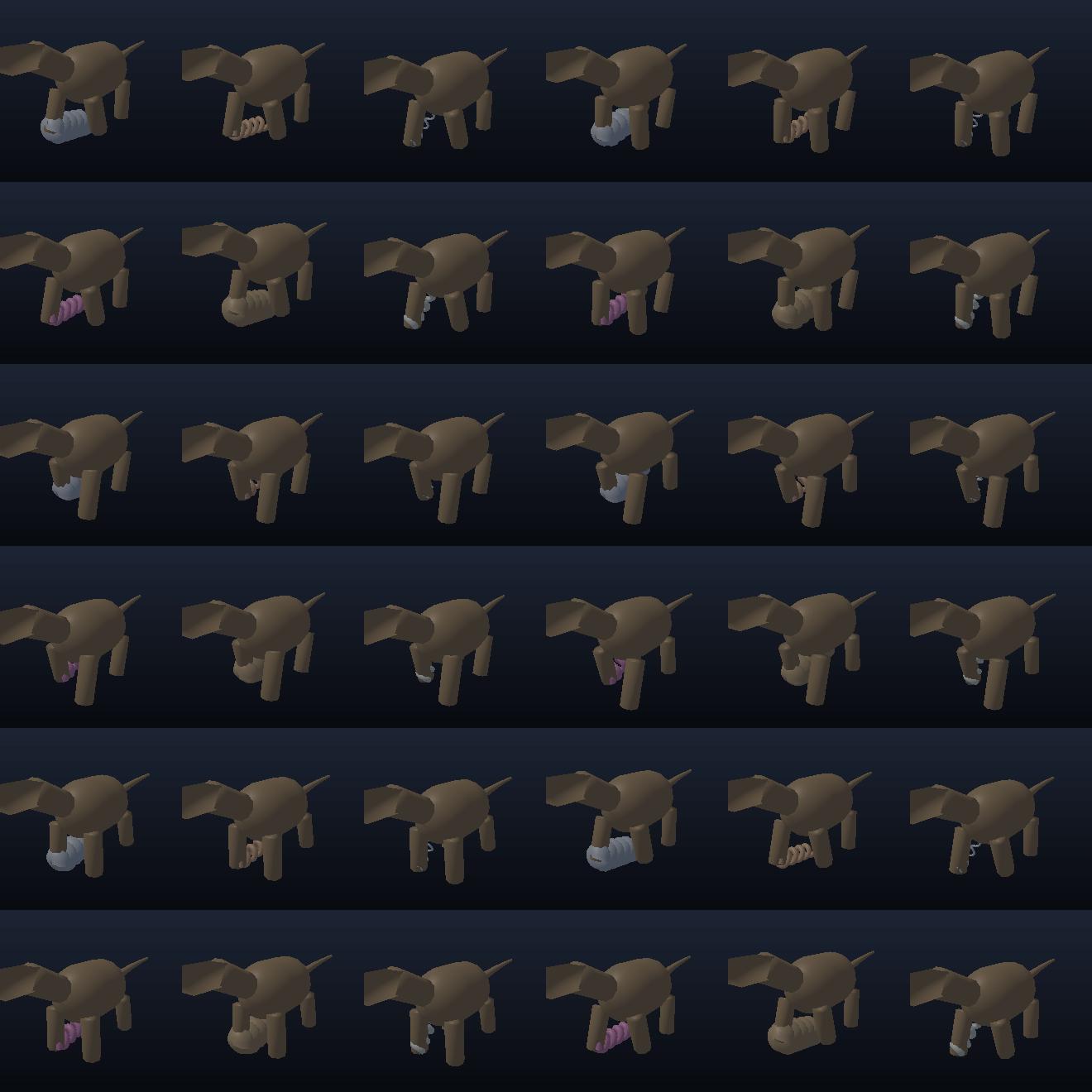
Attach anything to anything that's already moving
Every existing ObjectKit scene is a flat list of parts with absolute transforms — no parent/child hierarchy, no sockets, no attachment concept at all. RigCraft's attachment layer adds one: a part's world transform is its parent segment's own animated transform, composed with a local offset the part carries around forever after.
- Freehand — any offset, including one that floats well clear of the parent's surface. Nothing requires the meshes to touch.
- Snap rings — N parts spaced evenly around a limb's circumference, generated, not placed by hand.
- Zero changes to ObjectKit itself — the whole mechanism bakes a world matrix into a part's own vertices before handing it to the existing scene, so nothing about an already-shipped animation changes underneath it.
Find the moving parts without reading a line of gait math
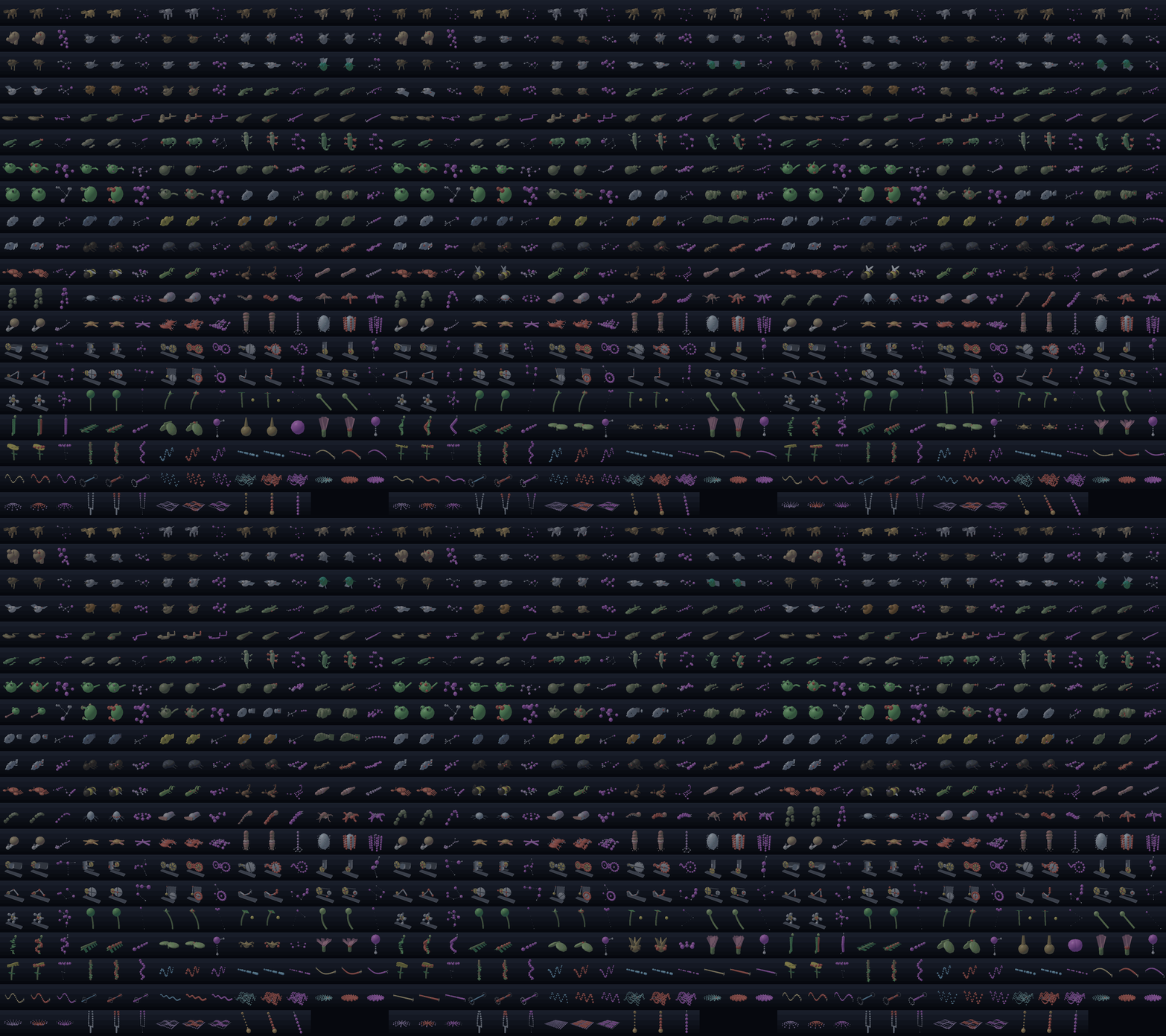
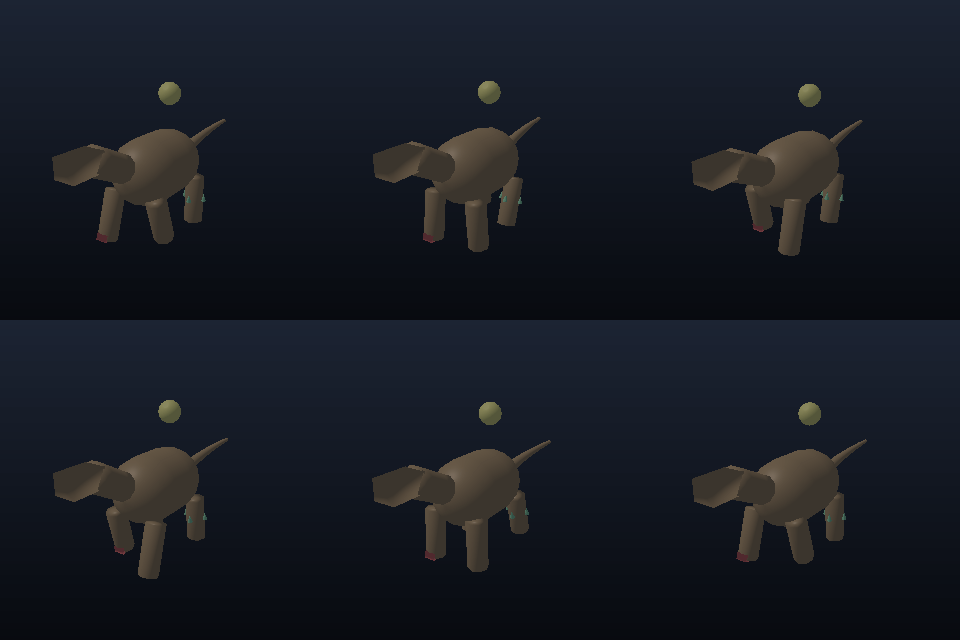
Every animated clip in the catalog shares one shape: a pure function from phase to a scene of parts. Sample the same clip at twenty phases and diff each part's position and rotation across the samples — the parts that barely move are scaffolding, the parts that swing far are the real attachment points. No per-creature rig math required.
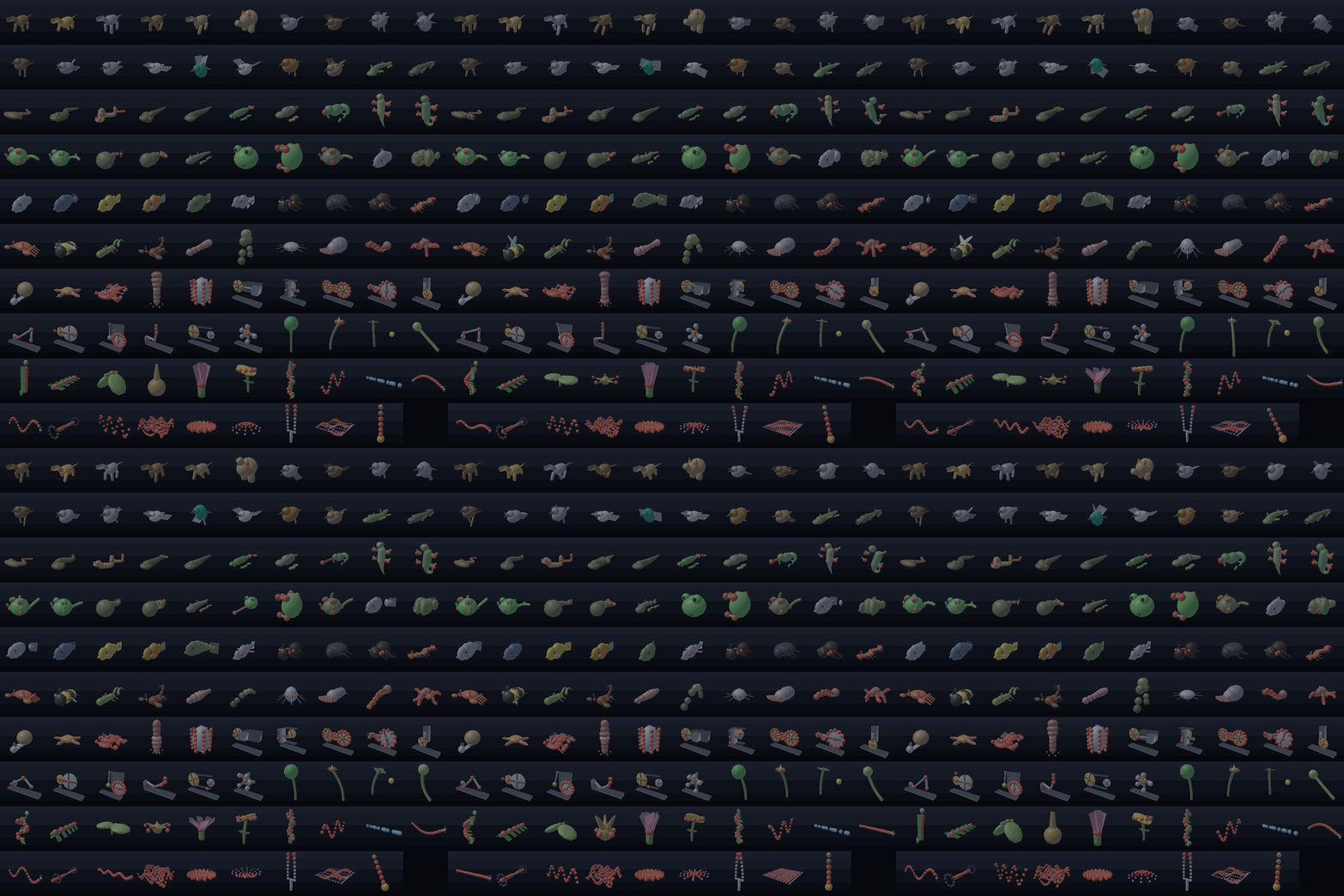
Run against all 99 clips, this technique needed zero special-casing for the extremes — a 227-part acoustic wave field and an 8-part quadruped walk both fall out of the same formula.
| part | score | read |
|---|---|---|
| front-left foot | 0.200 | primary hook |
| torso | 0.020 | scaffolding |
RigCraft Studio — build on any clip, in a browser
The full editor, not just a viewer: pick any of the 99 clips, choose a detected hook from a ranked dropdown, attach a rod, orb, box, or spring, and give it a real material. Parts link tip-to-tail like stacking in the VAB — a rod on a leg, a spring on the rod's end, an orb dangling off the spring — and a floppy parent carries its whole subtree with it. Every part edits live (ring angle, length, scale, material) and has actions: poke it, crush it until it permanently breaks, heal it straight again. Whole crafts copy and paste as JSON.
Runs entirely in-browser — no server, no network calls WebGL canvas, reused from the sibling ObjectKit viewer Actions map onto the physics model's own API — nothing invented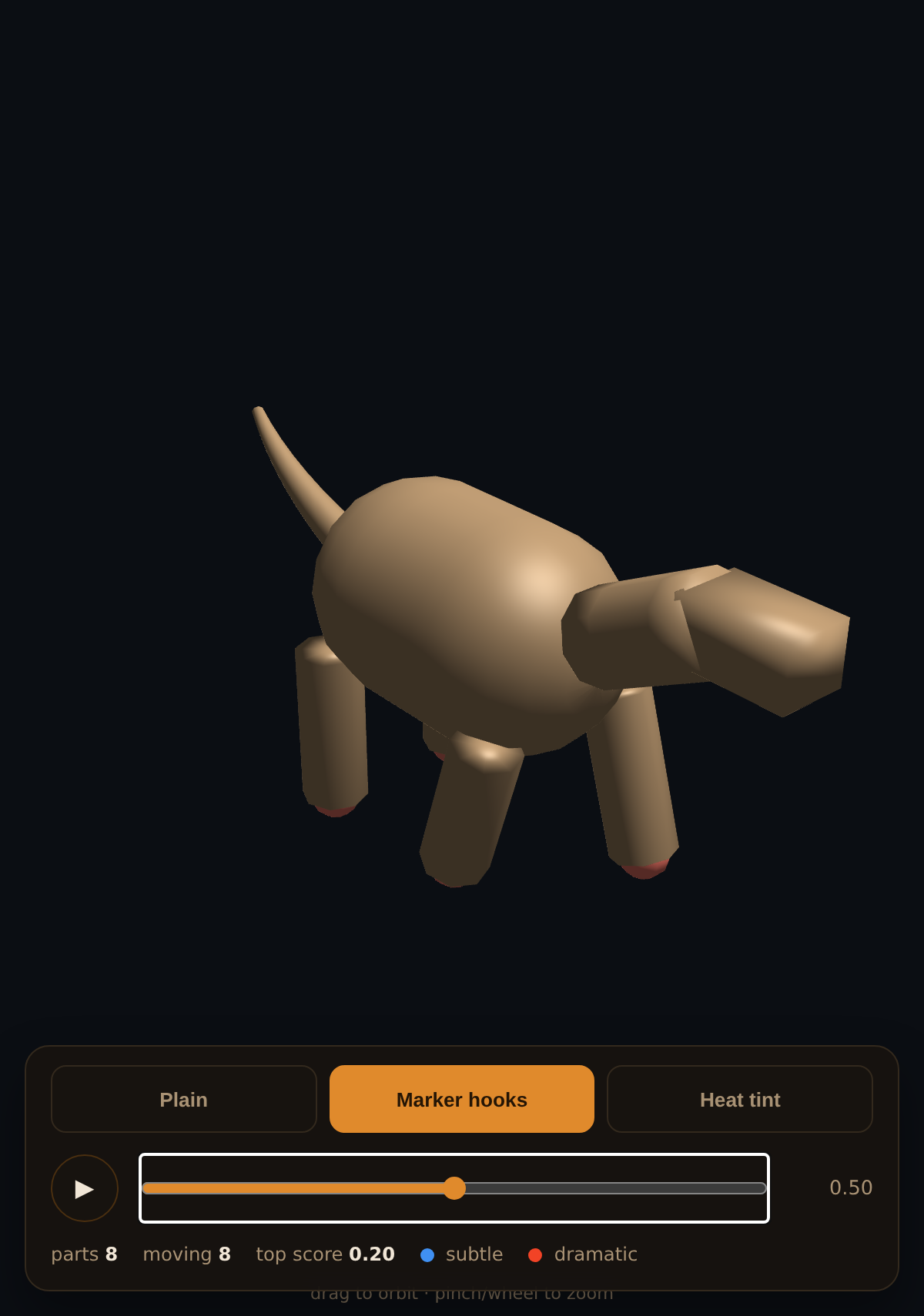
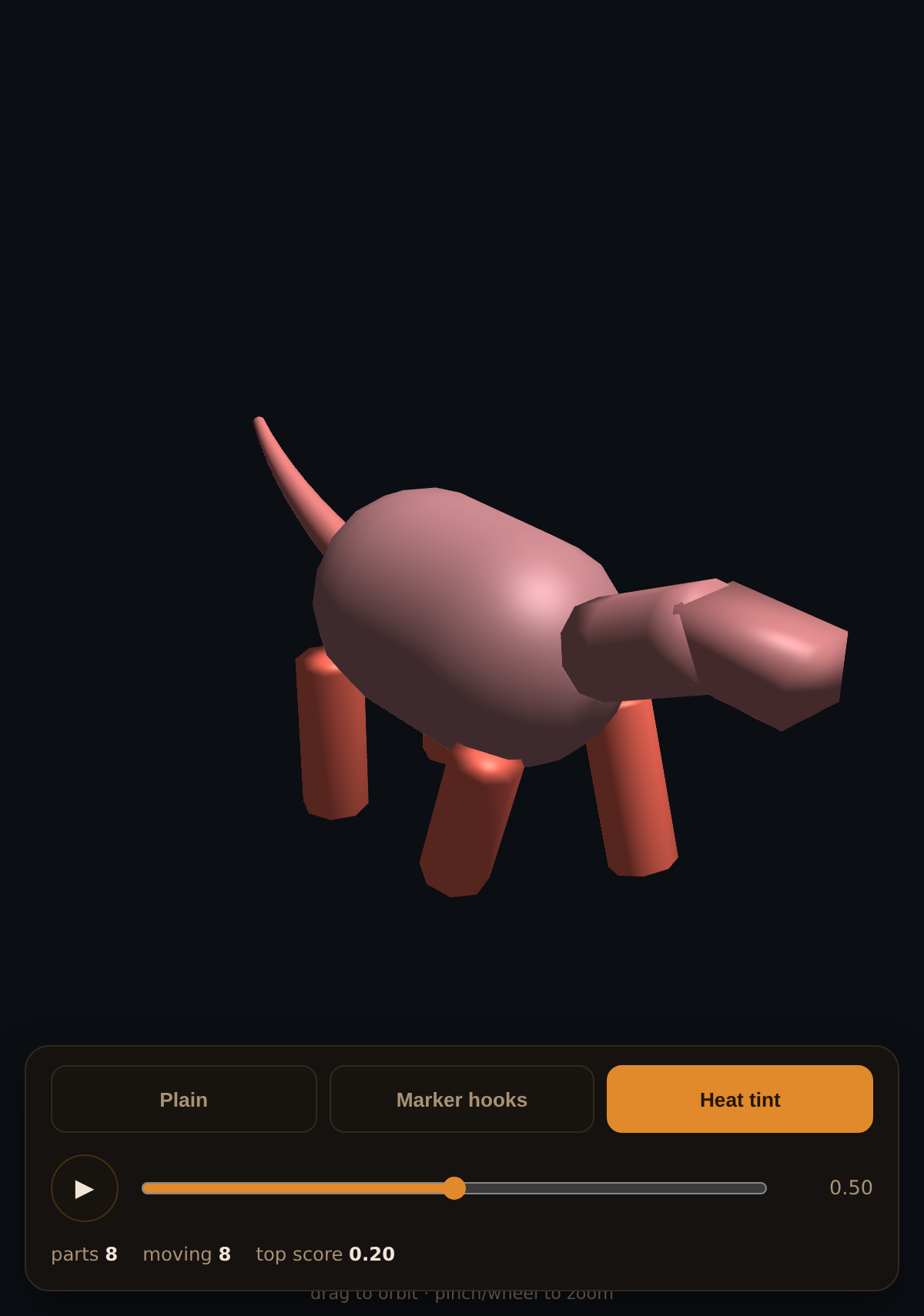
Steel and aluminum foil are not the same rod
A part's material now drives real physics, not a cosmetic tint. Density and stiffness come from the repo's own Chemistry.Materials catalog — real ASTM steel, aluminum, copper — fed through textbook cantilever-beam formulas (k = E·I/L) into a damped torsional spring reused verbatim from GameDevelopment.Vegetation.VegetationBend: built for a blade of grass, which turns out to be exactly a small cantilever with plastic "trample" memory.
Foil isn't a fictitious "foil modulus" — it's the same aluminum alloy as a rigid rod, at a radius roughly a hundred times thinner. Beam stiffness scales with radius to the fourth power, so the honest geometry alone is what makes identical metal collapse floppy and stay creased.
| material | rest bend | permanent set |
|---|---|---|
| steel rod | 2.4° | 0% |
| wooden stick | 2.4° | 0% |
| copper wire | 5.9° | 0% |
| pipe cleaner | 30.2° | 26% |
| aluminum foil | 51.6° | 100% — broken |
| string / twine | 57.3° | 0% — never holds a crease |
Springs, coils, and slinkies
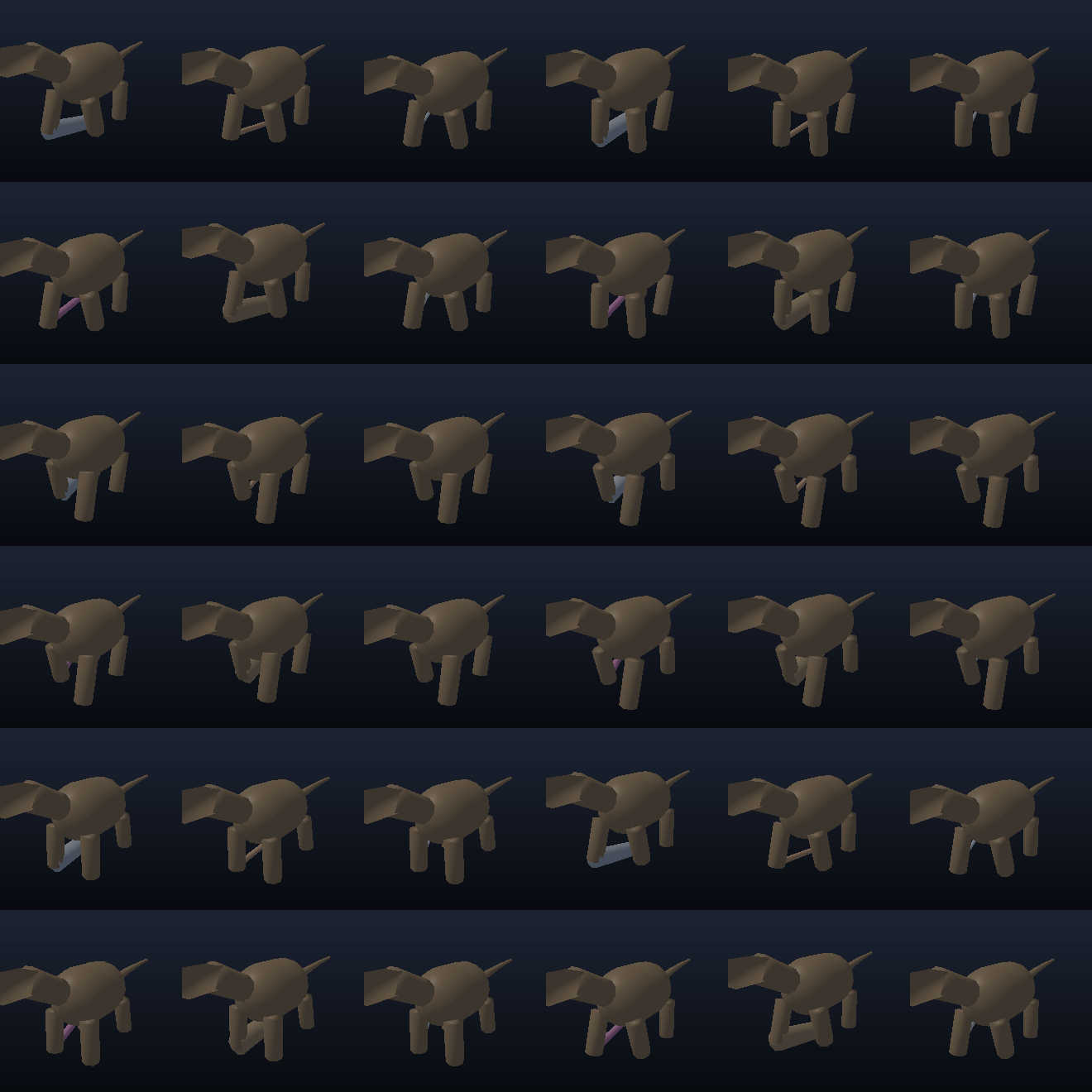
No helix/coil/spring primitive existed anywhere in the mesh library before this — every existing shape swept a profile around a single straight axis. A coil sweeps a tube along a path that turns and rises at once, using an analytically stable frame at every ring (a helix's tangent is never parallel to world-up, so there's no per-ring twist to fight).
The material system needed zero changes to work on the new shape — it only ever reads a material preset and a lever-arm length, never the mesh geometry — which is the actual proof that this generalizes past one whisker-shaped demo part.