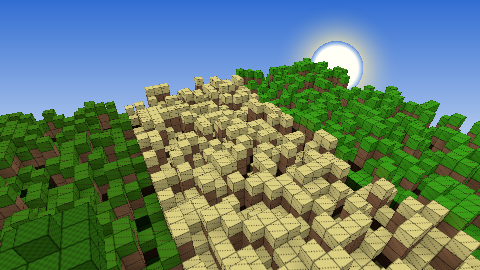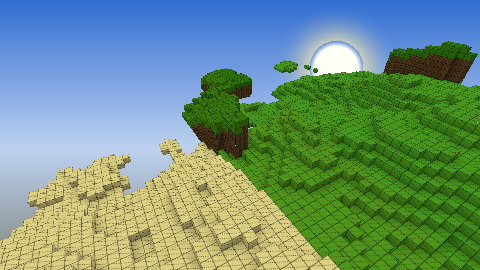
FBM value-noise carves a heightmap with per-column biomes; grass and dirt are tinted by biome, viewed from 18 blocks above the highest peak the generator found near origin.
Software voxel renderer
No GPU, no game engine, no NuGet. A hand-written software rasterizer meshes voxel chunks, shades every face with ambient occlusion and biome tints, draws a procedural sky and sun, then writes its own PNG. It generates terrain from value-noise, renders a hand-placed block showcase and the survival HUD, and loads a genuine Anvil (.mca) save by decoding level.dat and its NBT chunk sections.
FBM value-noise carves a heightmap with per-column biomes; grass and dirt are tinted by biome, viewed from 18 blocks above the highest peak the generator found near origin.
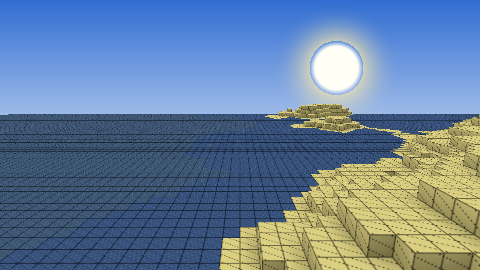
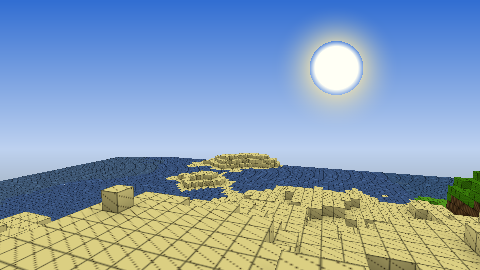
Eye-level camera across a desert biome: the noise field drops sand instead of grass, with a sea flooded to sea level on the far side. Perspective projection plus a radial sky-to-horizon gradient.
Fifty blocks east of the peak, the terrain dips below sea level and floods. Water blocks are depth-sorted and blended translucent over the sand and stone behind them.
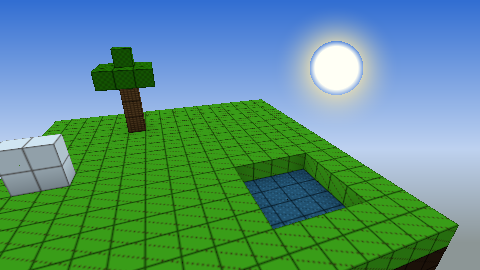
A hand-placed diorama: grass-over-dirt-over-stone floor, a two-deep water pool, an oak-log-and-leaves tree, and a glass wall. The jungle biome tint pushes grass and leaves lush green.
A genuine Anvil region loaded with --world: it gunzips level.dat, reads the spawn point (32, 64, 32), decodes the palette-packed NBT chunk sections from r.0.0.mca, and auto-frames the camera above spawn.
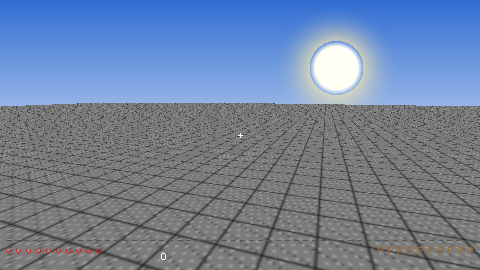
The same rasterizer composites the survival interface source-over the 3D frame: hotbar, health and hunger rows, XP counter and a centered crosshair, plus the glowing sun sprite.
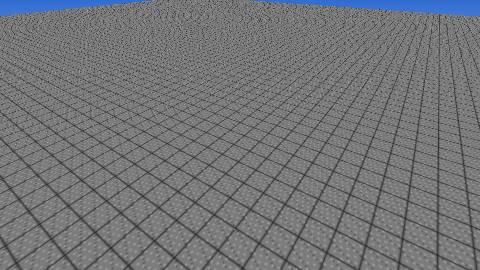
The built-in flat-world source: an infinite stone plate. An angled camera shows the greedy-meshed grid receding to the horizon, every voxel edge darkened by ambient occlusion.
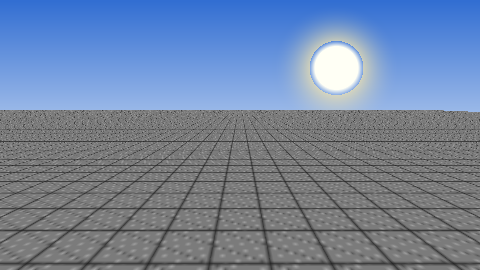
The same plate at eye level. The perspective camera and depth buffer resolve thousands of block faces into a clean horizon line under the procedural sky gradient.
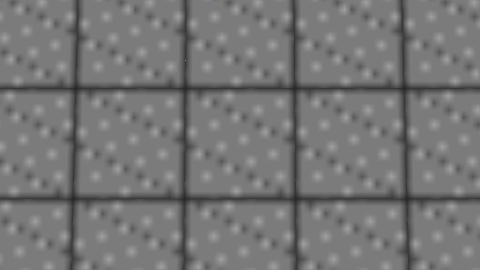
An 88-degree straight-down shot onto the block tops. Up close you can read the per-voxel stone texture and the ambient-occlusion darkening that thickens toward every seam.
A block source answers "what voxel is at (x, y, z)?" - a flat plate, a value-noise generator, a hand-placed diorama, or a decoded Anvil save. A chunk mesher walks the blocks and emits only the faces that touch air, merging coplanar runs into fewer quads. Each vertex carries light, biome tint and ambient occlusion; a scanline rasterizer with a depth buffer fills the triangles, the sky and sun are drawn behind, the HUD over the top, and the finished pixels are packed into a self-written PNG. Every part - NBT parser, Anvil reader, 3D math, rasterizer, PNG encoder - is plain C# on the .NET base library alone.