Seven generators, one seed each
The old-school toolbox for building worlds from noise.
Before "procedural" meant machine learning, it meant a handful of small, sharp algorithms: rewrite a string into a plant, split a rectangle into rooms, smooth random noise into caves. Every image below was generated and rasterised in pure C# - no art assets, no libraries beyond the .NET base class library. Reload and reseed to get a different world.
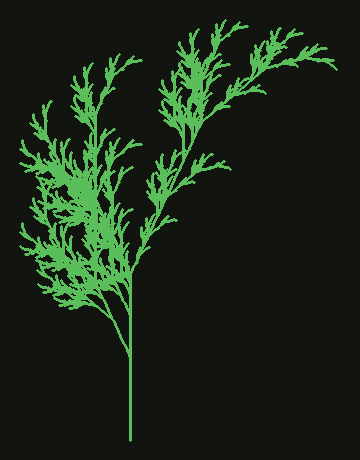
L-system
A plant from a rewrite rule
Start with "X", apply Lindenmayer's plant rules six times, then drive a turtle through the resulting string. Brackets push and pop position, so one line of grammar branches into a fern.
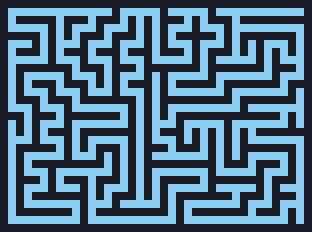
Recursive maze
A perfect labyrinth
Depth-first backtracking carves a maze with exactly one path between any two cells, then a touch of braiding removes a few dead ends to create loops.
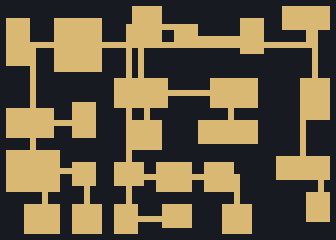
BSP dungeon
Rooms by recursive splits
Binary space partitioning slices the map into ever-smaller rectangles, drops a room in each leaf, and threads elbow corridors back up the tree. The roguelike staple.

Cellular automata
Caves from smoothed noise
Fill the grid at random, then repeatedly turn each cell into whatever most of its neighbours are. Five passes of this "4-5 rule" and static becomes a connected cavern.
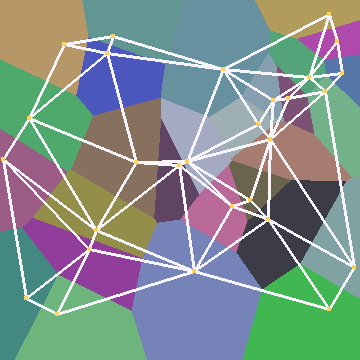
Voronoi diagram
Territory from points
Every pixel is coloured by its nearest of 28 sites - the Voronoi partition. The white mesh is the Delaunay dual that connects neighbouring sites.
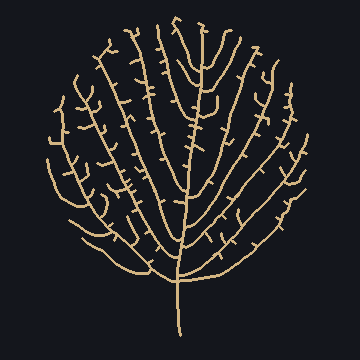
Space colonization
A tree that grows toward light
Scatter "auxin" attractors in a crown; the trunk grows toward the nearest ones, consuming each as a branch reaches it. Runions' colonization algorithm, node by node.
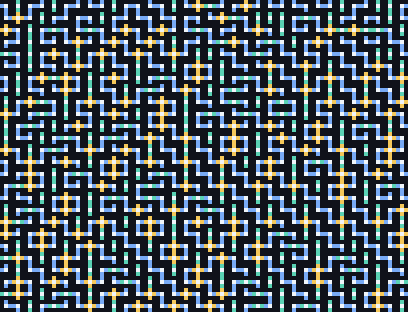
Wave function collapse
A network that always connects
Each tile carries edge connectors; a cell can only collapse to a tile whose edges match its neighbours. Solve the constraints and every pipe joins - the signature WFC look.