Chemistry that draws
Two chemicals. One grid. Patterns nobody painted.
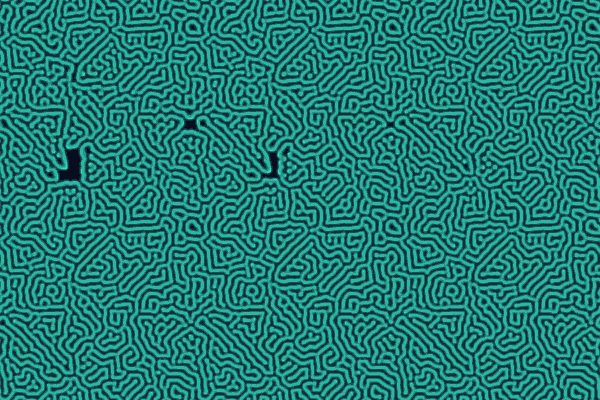
Feed chemical A everywhere, let B eat it, let both blur into their neighbours. Tune the feed and kill rates and the grid organises itself into spots, stripes and branching mazes - Alan Turing's 1952 prediction, running live and looping here.
One update, applied everywhere
The whole system is two lines
Each cell holds two concentrations. Every step, a 5-point Laplacian blurs each chemical, B is produced wherever A and B already meet (the A·B² term), A is topped back up, and B decays:
B' = B + (Db∇²B + A·B² − (F+k)B) dt
Two numbers - feed rate F and kill rate k - decide everything. Nudge them a few thousandths and a field of spots becomes a fingerprint becomes a coral reef. The hero above is a maze regime, seeded from scattered blobs and left to churn for thousands of steps.
Same code, five parameter pairs
A field guide to the soup
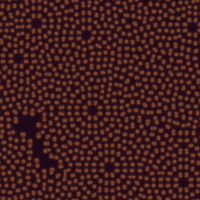
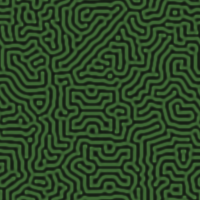

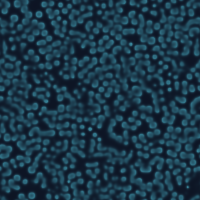

Each tile is 200 x 200, run 7,000-9,000 steps from the same seed. The feed/kill pairs are retuned for this renderer's diffusion constants - the classic textbook values sit right on a decay boundary here and fade to nothing.