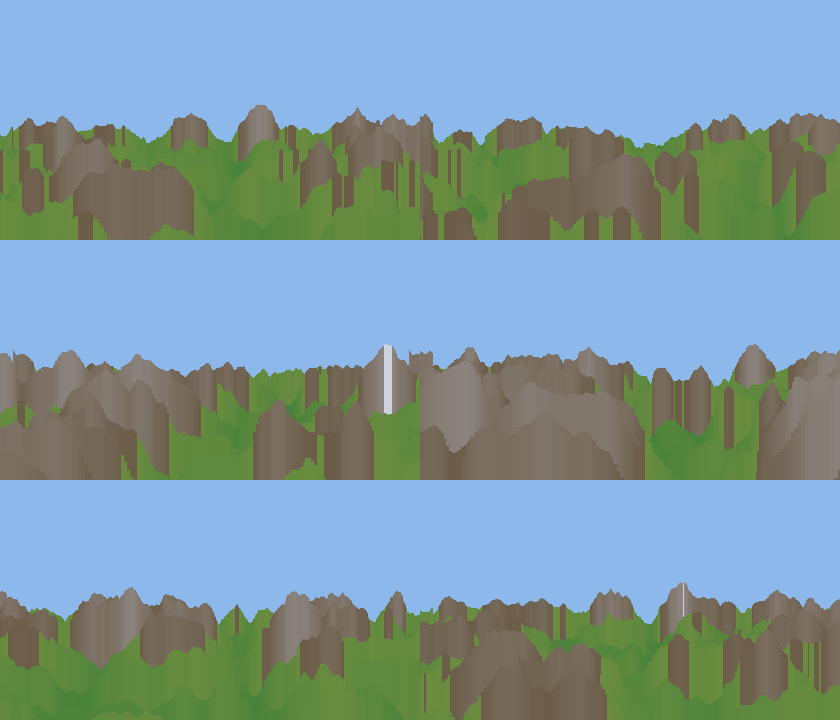
Rendering, 1992 edition
A landscape drawn one screen column at a time.
No mesh. No vertex buffer. No triangle setup. This flyover casts a single ray per pixel-column across a heightmap and paints the vertical span it uncovers - the trick NovaLogic shipped in Comanche: Maximum Overkill when GPUs did not exist.
The core loop
Three ideas, about twenty lines
March front to back
Step outward from the camera, doubling the step length as distance grows. Far columns sample the heightmap coarsely - free level-of-detail, no LOD bookkeeping.
Project each height
For every screen column, convert the terrain height at that sample into a screen row. The heightmap is the geometry; there is nothing else to transform.
Fill and remember
Paint from the new top down to that column's previous highest row, then raise the cursor. A near ridge always occludes a far valley - occlusion for free.
Why it still matters
The anti-rasteriser
Column raycasting was how flight sims and the original Delta Force drew sprawling outdoor terrain on a 486. It is embarrassingly cache-friendly, trivially parallel per column, and produces that unmistakable soft, dense horizon. Here the heightmap is fractal-Brownian noise sampled on a ring so the terrain tiles perfectly in the direction of travel - the camera crosses the whole 512-unit map and the animation seams into a clean loop. Everything above, from the noise to the GIF encoder, is written against the .NET base class library and nothing else.
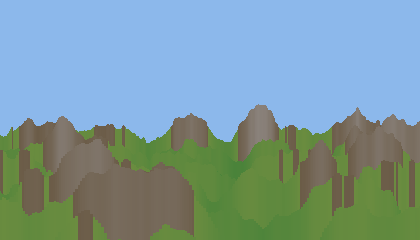
A single frame. Grass, rock and snow are keyed off normalised height; the sky is a flat fill behind the highest column.